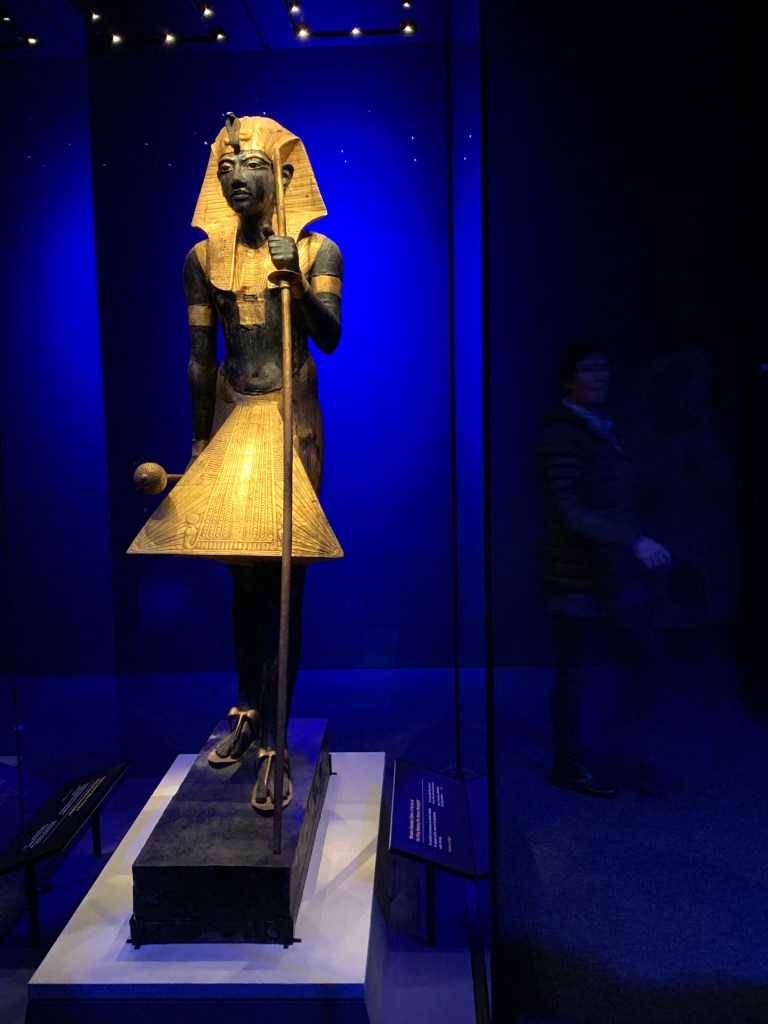
My own photo, captured during a visit to the Tutankhamen Exhibition in London in 2020.
In our own way, we all need something to believe in. Walter, one of my favourite fictional characters, looks to nature in his attempts to understand the world. We first meet Walter in The Forgotten Children,when Emily travels to the isle of Anglesey, and on a clifftop walk she encounters a gentle stranger…
‘Today it is a bright summer’s day, with a strong wind blowing, making the clouds scud across the sky as if they are racing with each other. As we approach the cliff-top the wind is even stronger and in places I need to turn sideways into the wind to catch my breath. When we reach the bench Ralph’s new friend is already there, sitting with his back to the wind. On his lap he has a sketch pad. ‘Good morning. May I?’ I say, pointing at the bench beside him. ‘Be my guest,’ he replies and shifts across a little to let me sit down. ‘Looks as though it’s you who is the artist,’ I say, pointing at the sketch pad. ‘Just messing.’ He moves his hand away so that I can see his drawing, which is a beautifully detailed picture of a seagull. ‘That’s a lot more than messing, it’s stunning. You have a real talent.’ ‘I wouldn’t say that.’ ‘Do you sell your drawings? I’m sure you could.’ He laughs and shakes his head. ‘Nothing like that, it’s just a pastime. It’s seen me through some difficult times. Shall we walk?’ He closes his sketch pad and puts it into his rucksack. ‘I’m guessing your young man here would like to stroll?’ ‘Seems he’s decided you’re his new best friend.’ ‘I’m honoured,’ he says, as he bends to stroke Ralph’s head. ‘The view is magnificent from here, I can understand why you’ve chosen this bench as a favourite spot.’ ‘No boundaries, just the horizon. And the more I move towards it, the more it moves away.’ ‘This place shows nature off at its best, doesn’t it?’ I say. ‘Nature?’ ‘Yes, living here must make you really in tune with the countryside.’ ‘I’ve learned to be. There’s usually work on all the farms hereabouts, picking crops, clearing fields, mending fences and in the spring I get to help with lambing.’ ‘And you live on the farm?’ ‘Home is a campervan. I park up wherever there’s work.’ I have an image of his van, all his worldly goods around him. ‘Is it just birds you draw?’ ‘I draw what I see. There are many ways of looking you know and many levels of seeing,’ he says. ‘How do you mean?’ ‘You and I might look at the same tree and see different things. I might see a chance for shelter from a rainstorm. You might see something that obscures your view, a lost opportunity to see the horizon.’
From ‘The Forgotten Children’ by isabella muir
I can only imagine how Walter would react to life today, with virtual reality and AI filtering into our lives in more ways than ever. As a result many of us struggle to determine fact from fiction. Perhaps people have been asking ‘What is truth?’ for centuries, but now, with mass media playing such a major role in our lives, it is more and more difficult to pin down reality. Tricks and tricksters are there, waiting to catch us out, with spam emails or phone calls that persuade you to ‘sign up’ or worse still, to part with your money.
Belief in the supernatural has been around forever, forming the basis of religion and many cultural practices, continuing to exert a powerful hold in many parts of the world. But in the early part of the 20th century some argued that religion had lost its enchanting and mystical associations, replaced with the rational, the scientific and the secular; a process described by the sociologist Max Weber in a 1917 lecture as “the disenchantment of the modern world”.
Rolling forward into the 21st century, historians have begun to question the idea that modernity is totally disenchanted and rational, suggesting that, aside from religion, there are many aspects of contemporary societies that are decidedly subject to processes of enchantment. Perhaps no longer located in beliefs in the supernatural, but rather in novel forms of fictional imagination and popular culture.
Anyone who has read fiction will know the joy of immersing oneself in an imaginary world. After all, that is what storytelling is all about! Fiction – whether that be in books, theatre, or film – enables us to take a step away from our day-to-day life, often it also gives us a chance to learn something about what it means to live in someone else’s shoes.
Perhaps these imaginary worlds also provide a safe framework to discuss issues that could otherwise be tricky. An after-dinner conversation about the good and evil portrayed in Tolkien’s Middle Earth is less likely to end in a heated debate than attempting to unravel Middle East politics, for example.
As a child many of us believed in Santa Claus and maybe even felt loath to let go of that magical thrill knowing that somehow Santa and his reindeers would negotiate houses and flats, many without chimney pots, to bring gifts to everyone during the space of one night!
With the rise of virtual reality and computing gaming, young people have easy access to escapism, perhaps becoming so immersed in these ‘other worlds’ that it becomes difficult for them to separate the real from the imaginary. ‘Fake news’, ‘doom scrolling’, conspiracy theories, and the darker sides of social media, have provided alternative (and dangerous) routes for those looking for answers.
Fascinating to reflect that around a hundred years ago, in 1922, when Howard Carter and Lord Carnarvon’s discovered Tutankhamen’s tomb it prompted a new wave of popular interest in ancient Egypt that suffused British culture. Britain fell under the ‘Tut-ankh-amen spell’, with that spell cast over movies, music, mummies, and more.
The timing of the discovery, coming as it did just after the end of the First World War, with the loss of more than ten million lives, must have fulfilled a desperate need for something else to believe in. So-called ‘civilisation’ had done nothing to prevent destruction; perhaps looking to the supernatural would provide the answer.
In her article, Tutankhamen, Egyptomania, and Temporal Enchantment in Interwar Britain, Allegra Fryxell, explains:
Literally clothing themselves as ancient Egyptians or believing in the curse of the mummy, Egyptomania tapped into Victorian beliefs in mysticism and the occult, presenting a ‘deeper reality’ to life in the modern world …
Disenchantment led many Britons to search for enchantment by other means; fantasy filled this void by framing ‘virtual realities’ into which readers could escape (even ‘inhabit’) through interwar popular fiction, fanzines, clubs, and conventions, a re-enchantment requiring both ‘mystery and wonder’.
Tutankhamen’s tomb, and the Valley of the Kings in general, appeared to modern Britons as a world ‘aloof from the restless developments of the outer world’, a ‘peaceful serenity’ undisturbed by modern technologies like wireless telegraphs or aeroplanes.
Just as in recent posts, I have raised the notion that much of what we experience today is merely a repetition of the past (albeit it slightly altered) so, Fryxell tells us:
The public was fascinated by the notion that contemporary standards of beauty paralleled those of ancient Egypt, seemingly surprised that ‘low-necked dresses cut just like the present-day frocks were in fashion in ancient Egypt about 5,000 years ago… Gloves, slippers, jewellery, cosmetics, and even bedsteads, have altered little in 5,000 years save in magnificence’. The svelteness of Egyptian women was frequently emphasized, corsets were ascribed to pre-Hellenic times, and earrings were ‘nothing new’ for ‘the modern woman who adopts this mode is only following a fashion almost as old as history itself’. Artefacts of everyday value such as bread, sandals, perfume, and cosmetics were repeatedly photographed, discussed, and replicated—indeed, a Times correspondent went so far as to suggest that Tutankhamen’s mortuary goods could be sold in West End shops.
A small wheat seed, supposedly taken from a sack of grain found in the tomb, somehow made its way to Australia from Egypt, whilst in New South Wales a farmer claimed to have grown a crop of wheat from Tutankhamen’s time, although this was later exposed as a fraud. Another 2,000-year dormant seed that had yielded new grains was proudly displayed at the Newcastle Agricultural Show in 1936. Similarly, Herman Trelle (the ‘wheat king of the world’) had returned to Canada from Egypt in 1931 with a wheat seed that he grew on his Alberta farm and entered in the Chicago International Grain Exhibition, reportedly hoping that Tutankhamen’s tomb might also serve as a ‘storehouse’ for surplus Canadian grain. Meanwhile, chemists performed experiments on pots of cream and ointments uncovered in the tomb to determine the exact elemental composition, so that British women could smell like Queen Ankhesenpaaten, Tutankhamen’s wife. The tangible realities of Egypt were not limited to foodstuffs and scent: even the sounds of the ancient world were reproduced. The BBC recorded horn-player James Tappern playing two trumpets found in the tomb on a Sunday afternoon in 1939 that literally recreated the music of the pharaoh’s court for listeners across Britain.
Perhaps as human beings we need myth and magic. Rational science has provided us with explanations about how the world was formed, with the ages of the universe, our galaxy, the solar system, and Earth all estimated using modem scientific methods. Darwin’s theory of evolution challenged the idea that God made all the animals and plants that live on Earth, suggesting all organisms alive today – including mankind – evolved from simple life forms.
During the 1960s, scientific developments lead to lunar exploration, with man stepping onto the moon for the first time in 1969. Neil Armstrong’s famous words, “That’s one small step for man, one giant leap for mankind,” suggested that by exploring the universe we could somehow discover concrete answers to explain the meaning of life on earth.
With rational theory and scientific fact it is harder than ever to believe in the Creation as a supernatural wonder, leaving many to doubt if there is something or someone ‘out there’ steering our future and looking out for us. Nevertheless, it seems that many continue their search and continue to ask, how and why.
In the next post in this series – The haves and the have-nots – I consider inequality in all its forms.
Just click on ‘subscribe’ on the home page to follow my website, to ensure you don’t miss out on forthcoming articles.
To continuing exploring the topic of enchantment, take a look at:
Michael Saler, As if: Modern Enchantment and the Literary Prehistory of Virtual Reality.
Allegra Fryxell, “Tutankhamen, Egyptomania, and Temporal Enchantment in Interwar Britain”, Twentieth Century British History, Volume 28, Issue 4, December 2017, Pages 516–542,
I think imagination helps us admire the world we live in. Science has brought new questions and new wonders, and it is not incompatible with imagination. Escapism is a different thing. It’s putting ourselves in a world that is not real. I personally enjoy this world very much and I think all we need is to pay attention to what is happening around us (outside the computer and the television) to get ourselves marvelled at it.
I agree! Imagination is precious and perhaps is the one thing that led all the great inventors and scientists to push the boundaries, to seek answers to the ‘why?’, ‘how?’ and ‘what if?’!
[…] is, how certain can we be that we are really considering ‘facts’. In a previous blog post, What is real? I raised the challenges posed in the present day by ‘fake news’. But knowing how to establish […]


 Isabella Muir
Leave a reply to Ana Catarina Palma Neves Cancel reply