Some say it was during the 1960s that the idea of ‘the generation gap’ entered into popular usage. It became a useful phrase that summed up the differing attitudes towards politics, behaviour, music, fashion and virtually everything else between the young and the old — with the ‘old’ including everyone over 30.
Children born after the war ended entered their teenage years in the sixties. They knew little or nothing of their parents’ experiences during the six years of conflict, with rationing the only remaining constraint on life until the mid to late 1950s. Parents rarely spoke about the trauma, neither fathers who had seen the fighting first hand, or mothers who were scared witless as the bombs fell around them.
As the 1950s came to end, Prime Minister Harold MacMillan told a political rally that the people of Britain ‘had never had it so good’. The NHS offered free healthcare to all, something that just a decade earlier must have seemed like an impossibility. Labour-saving devices and consumer goods, such as fridges, televisions, washing machines and vacuum cleaners tempted families to sign up on the ‘never-never’ paying weekly or monthly for something they were certain would make life more comfortable.
The older generation had vivid memories of hardship. For many, no sooner than the First World War ended than the depression of the 1930s hit hard, followed by more fear and loss during the Second World War. For some, that fear translated into caution, a fervent desire to keep their loved ones safe. So, when the young wanted to shake off the constraints of their parents, turn routine and expectations upside down and strive for the new, it wasn’t surprising there was conflict and misunderstanding.
In Flashes of Doubt we glimpse the differing perspectives of recently retired, William Arnold, and sixteen-year-old Peter, as they experience the political events of 1962. On their first meeting, William wants nothing to do with young Peter, and yet as time passes the older man begins to sense that the opinions of Peter and his young friends might be worth listening to…
Peter was quiet, focusing his gaze on the scene ahead of him. After a few minutes he said, ‘We do care, you know.’
His words took William by surprise, making him turn to look at Peter, hoping he would say more.
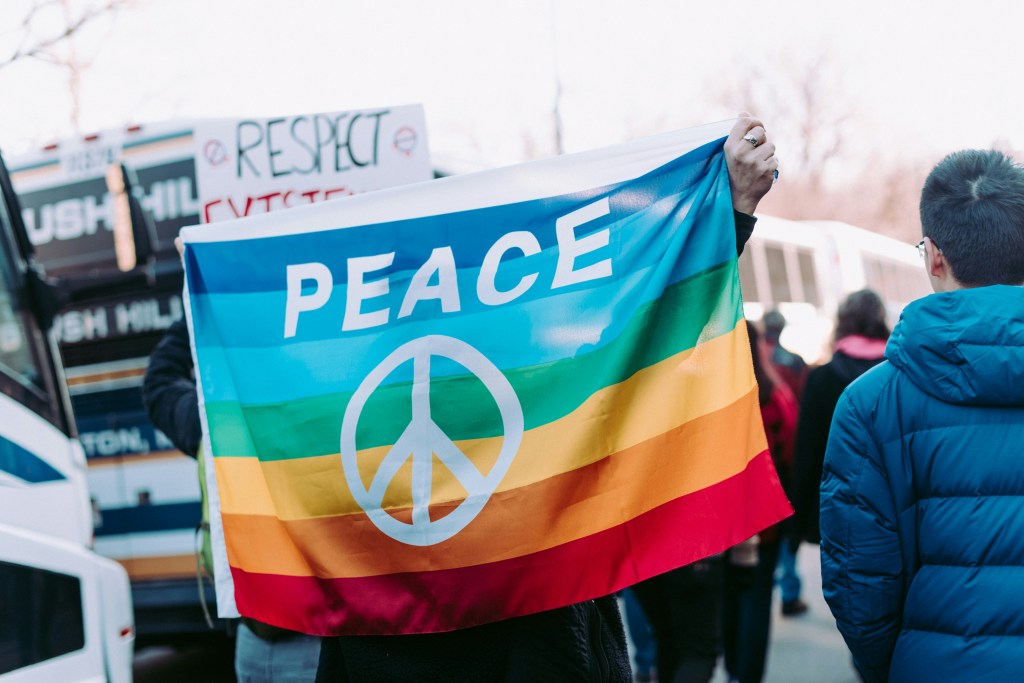
‘My generation. I mean, of course, not everyone, but at least my friends, the people I know well. We want to take the freedom you’ve given us, the freedom you all fought for, and do something good with it. That’s why there are marches, protests against armaments, nuclear weapons, CND, Ban the Bomb. You’ll have read about it, I know.’ He paused, as if frustrated he couldn’t find the right words to make his point.
‘Something good?’
‘Fairness, equality, safety…’
‘Grand words, lad.’
‘All I’m saying is that us youngsters might seem unruly to you, we might not follow the same rules, or like the same music,’ Peter paused and winked, ‘but we’re taking the next step along a path your generation started. We’re doing what we can to make sure there isn’t another war, and I believe if we keep shouting loud and long enough, we’ll make sure there really is “peace for our time”.’
William took note that his young friend knew his history. He was familiar with the oft-quoted words of Prime Minister Neville Chamberlain, who returned from a meeting in Germany assuring Britain the Munich Agreement would ensure the two countries would never go to war again. Instead, less than a year later, Europe saw the start of the Second World War.
‘Even the music we like, a lot of the lyrics explain how we feel about what’s going on around us.’
‘Think music is going to make a difference then, do you?’
Later, William regretted the irritability he knew could be heard in his responses to Peter. The boy challenged William’s thinking, something he wasn’t used to. It made him uncomfortable, but at the same time made him admire the young man. Not an emotion he had expected.
An extract from Flashes of Doubt – available in ebook or paperback.
Change can be uncomfortable, misunderstandings can lead to conflict, between nations, between populations, between families, between friends. But in Flashes of Doubt we see how crossing the ‘gap’, seeing the world from someone’s else perspective, might be one step along the path to greater harmony.
Just click on ‘subscribe’ on the home page to follow my website, to ensure you don’t miss out on forthcoming articles.
 Isabella Muir
Leave a Reply