For many people across the world, 1961 offered hope and optimism. For others not so much. On 20 January that year, John Fitzgerald Kennedy became President of the United States. In Whispers of Fortune we learn how the words of his inaugural speech crossed the Atlantic to be heard by a young woman who was deciding how to move her life forward – or if that was even possible.
‘When the thirty-fifth President of the United States was elected to office, Sally Hilton was worrying about the ladder in her stockings. It was her only pair and needed to last until payday on Friday. In his augural speech, John F. Kennedy promised significant change to his fellow Americans. In Britain, the sense of euphoria was contagious. If not us, then who? If not now, when? Powerful words spilled out from the skilled orator, and Sally Hilton, with her laddered stockings and empty purse, wanted to believe they would make a difference. Change was coming, not just for Americans, but for the ‘free world’, whatever that meant.’
An extract from Whispers of Fortune – available in ebook or paperback.
President Kennedy was the first Roman Catholic to take on the role, and at just 43 years old he was also the youngest. JFK was born into a wealthy family, one of nine children. His father, Joseph, was a businessman and politician and his mother, Rose, a socialite and philanthropist. The Kennedy family had strong Irish connections as all of John’s grandparents were children of Irish immigrants. Much has been written about the life and politics of JFK, not least how and why it came to such an abrupt end with his assassination in November 1963. It was a short but tumultuous presidency, including: Cold War tensions with Russia; decolonisation leading to countries struggling to achieve independence; the US invasion of the Bay of Pigs, following a year later to the Cuban Missile Crisis; and the Vietnam war. Alongside these events was the President’s push for civil rights for black Americans and his desire for racial equality.
In Britain, during Kennedy’s first year in office, people were finding their voice, with some parallels that could be drawn with US events. Following the Sharpeville massacre in South Africa on 21 March 1960, when 69 unarmed protesters were shot dead by the South African police, the British anti-apartheid movement took up the cause in 1961, determined to ‘keep South Africa’s apartheid policy in the forefront of British politics’. Other protests took place decrying nuclear armaments. In summer 1961, the Campaign for Nuclear Disarmament (CND) announced a new round of mass civil disobedience, in opposition to the arrival of the first US Polaris submarine in Holy Loch, Scotland. Polaris was the UK’s first submarine-launched nuclear ballistic missile system.
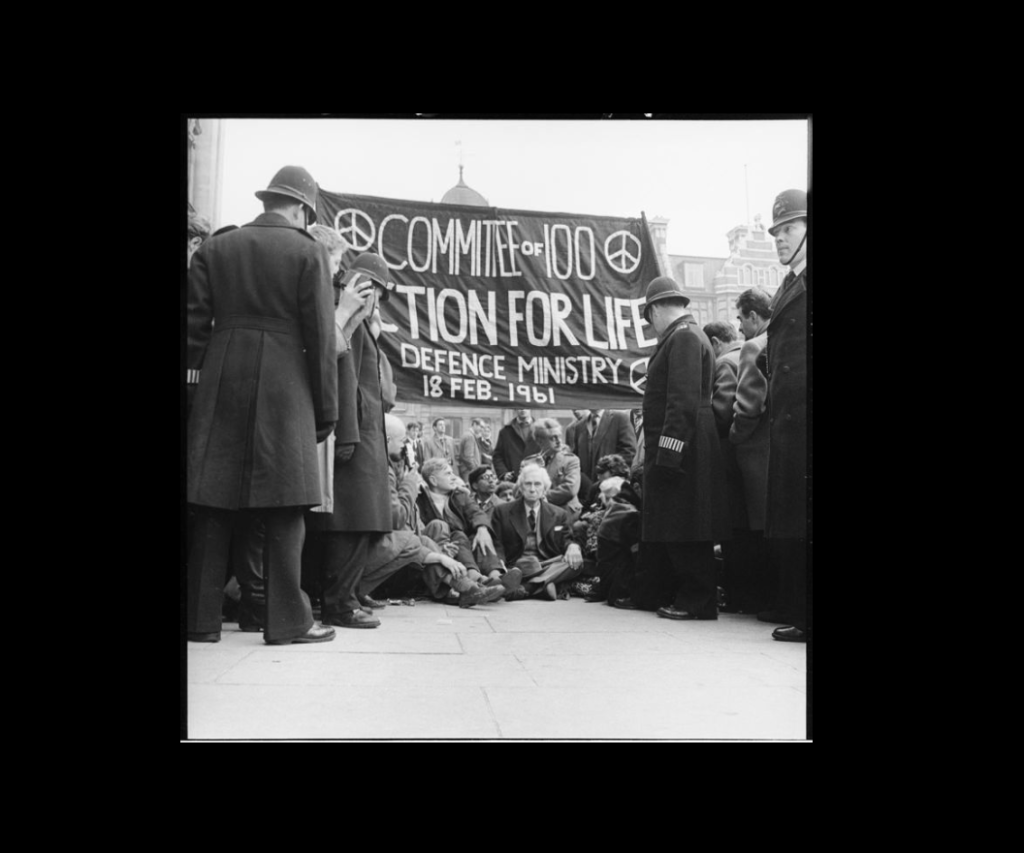
© Henry Grant Collection/London Museum
Creative commons usage: CC BY-NC 4.0
The photo above shows the founder of the CND, 89-year-old philosopher Bertrand Russell sitting cross-legged, facing the camera, at an Anti-Polaris Rally. Russell was renowned for his social activism and anti-nuclear protesting during the 1950s and 60s, for which he received a two-month prison sentence (reduced on appeal to one week). This Anti-Polaris sit-down protest took place outside the Ministry of Defence in 1961.
Voices continued to be heard throughout the decade, with tens of thousands protesting against the Vietnam war in the late 1960s, a war that over the nearly twenty years it was fought took the lives of more than a billion soldiers and civilians.
So, when you read Whispers of Fortune, consider the social and political backdrop during that year – 1961 – a time when Sally Hilton, like so many others, was searching for answers…
My next post looks at the fact behind the fiction of the third book in the series of Mountfield Road Mysteries – Flashes of Doubt – where a connection between generations leads to surprising insights.
Just click on ‘subscribe’ on the home page to follow my website, to ensure you don’t miss out on forthcoming articles.
 Isabella Muir
Leave a Reply