Browsing through the stories I’ve written over the years, it’s no suprise that I’ve chosen to step back from writing fiction for a short while, grabbing the chance to take a deep dive into the decades that have always been at the heart of my novels and novellas. So, in the next few blog posts, I’m going to look back at some of my stories and unravel the facts behind the fiction.
Let’s start with one of my Second World War novellas.
In More than Ashes the people of Tamarisk Bay are learning to deal with tragedy. It is one year after the start of the Second World War and coastal communities are having to cope with relentless German bombings. Hardship is affecting families on every level, from food rationing to clothing shortages.
Everyone is trying their best to make do. Then an item of clothing turns up in the Latimer household, just a short time after a gentleman’s outfitters is bombed. Nearby towns and cities are experiencing looting on a grand scale and there is talk of severe punishments being handed out – a lifetime in prison; maybe even hanging.
Has a crime been committed? Can Sergeant Snow root out the truth before the close community of Tamarisk Bay is split apart by suspicion and accusations?
Rationing
When World War II began in September 1939, 50 million ration books were distributed. Petrol was the first commodity to be controlled, followed by bacon, butter, and sugar. Gradually the list grew, with meat, tea, jam, biscuits, breakfast cereals, cheese, eggs, lard, milk, canned and dried fruit, eventually all rationed.
Here’s a memory that was shared on the BBC People’s War archive:
‘On the way back from the greengrocer’s, my mother would have called in at the butcher’s for a large bone. Stripped of its meat, she would then go on to boil it for several hours with vegetables and pearl barley for our evening meal — a sort of meat-flavoured soup. Ration books and identity cards were necessary for living, so everyone just got on with it.’
Then, as the war continued, rationing was extended to clothing, with a system of points allocated to different garments. Clothing coupons were issued, to be presented on purchase of clothing, shoes, and fabrics, alongside cash payment.
Different types of clothes were given different coupon values, determined by how much material and labour went into each item’s manufacture. For example, an adult’s skirt would require seven coupons and a pair of child’s pyjamas six coupons. As well as being used for clothing, coupons could be used for wool, cotton and household textiles, such as curtains or bedding.
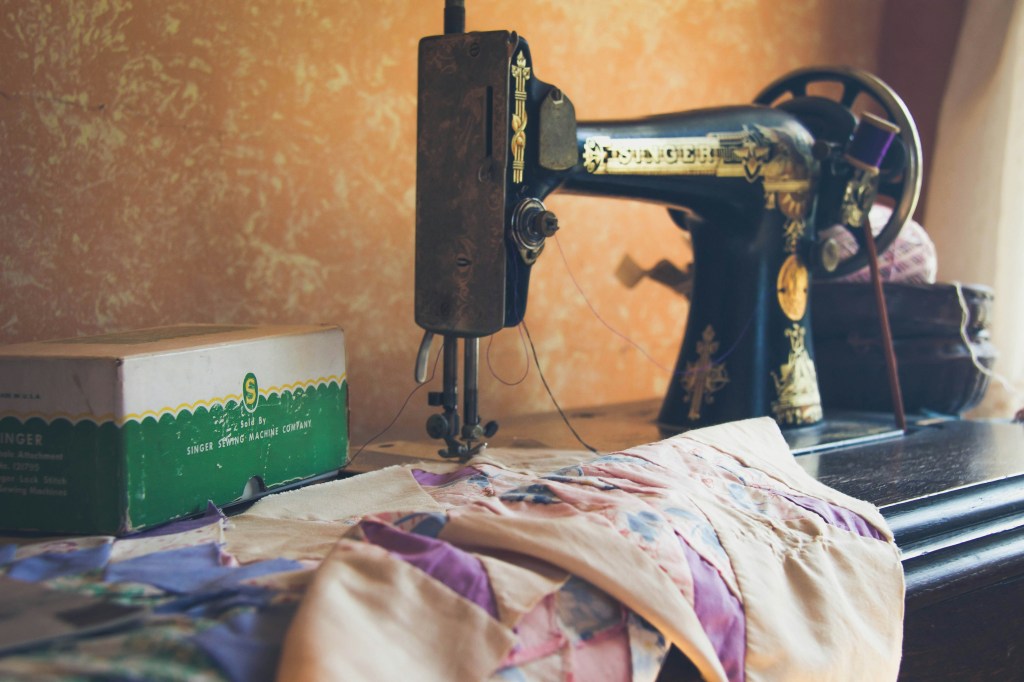
People were encouraged to ‘make do’, using and often re-using clothes and fabrics they already had. The government Make Do and Mend campaign offered practical guidance on caring for, altering, and mending clothes; instructional pamphlets were produced. In collaboration with voluntary groups, the scheme also offered classes in techniques, such as dressmaking. The pamphlets contained advice on different ways to mend, darn, and patch garments, how to protect clothing from moths, as well as instruction on re-modelling men’s clothes into garments for women or children. A man’s jacket could cleverly be made into a girl’s skirt, old woollen jumpers could be unravelled and knitted afresh into something new. And as Phyllis and Freda explain at the start of More than Ashes:
‘Curtains that may have been a little ragged around the hems could be trimmed and restitched to make a shirt or blouse.’

And while most folk were doing their best to ‘make do’, there were others who spotted an opportunity to make money. In 1943, in one operation, five million clothing coupons were stolen and the government had to cancel the entire issue.
Looting
Another reason for a significant rise in crime during the war years is explored in More than Ashes – looting. And it wasn’t only career criminals who found ways to take advantage of blackouts and bomb damage.
In fact, the government was so concerned about looting it brought in the threat of life sentences or even the death penalty as a deterrent. Although, perhaps with a view to the importance of morale, no-one was actually executed for looting and most were given heavy fines or short sentences.
Here’s an extract from a BBC article:
‘Bombed and abandoned buildings were a treasure trove for looters. After a raid on Dover, one man returned home to find his entire house stripped. Even the carpets and pipes had been taken by opportunistic thieves.
And these extracts from an article on the Guardian archives:
‘One trader in east London at the beginning of 1941 reckoned that shopkeepers lost more from crime than they ever did from German bombs.’
‘There was little the police could do to protect wrecked shops whose smashed windows were often just replaced with cardboard or plywood. Police cars were subject to the same petrol shortages as everyone else and pursuits during the blackout were almost impossible. Bill Biggs, now 100, was a police officer in London during the war and remembers spotting three men breaking into a clothes shop to steal suits and dressing gowns.’
But rising crime levels were just one aspect of life during those war years. Another, equally significant, but much more positive factor, was the way communities came together to support each other. We can see how this played out in my next post, which goes behind the scenes of another of my World War Two novellas. Never Enough explores the upsides and downsides of the mass evacuation of children that took place in September 1939.
Just click on ‘subscribe’ on the home page to follow my website, to ensure you don’t miss out on forthcoming articles.

 Isabella Muir

Leave a Reply